
Nigeria's Soldiers of Fortune
Q1 is almost over, so I'm nearing the end of my defined term for my personal curriculum. More on that next time but today, I'm sharing a review of a book I read on Nigerian political history, "Nigeria's Soldiers of Fortune" by Dr Max Siollun.

Also, I'm excited to be hosting a live conversation with Siollun on Sunday 12th April on Twitter/X. More details at the end of this article.
📒 Summary
The subtitle of the book is "The Abacha and Obasanjo Years", but the book primarily covers the events leading up to Abacha taking power as a military ruler, his infamous rule, the eventual election of Olusegun Obasanjo and, briefly, his first term.
The book starts with the events of June 1993, where military ruler General Ibrahim Babangida annulled the results of the presidential election and declined to cede power to Moshood Abiola. We then learn about how the Interim National Government, led by Ernest Shonekan, only lasted 82 days before there was a coup in which General Sani Abacha became head of state.
Over Abacha's almost 5 years of rule, the book discusses some key events; the "phantom coup" in which Lt-Colonel Yar-Adua and General Obasanjo were imprisoned; the unrest in the Niger-Delta region leading to the murders of the "Ogoni Four" and the subsequent imprisonment and hanging of Ken Saro-Wiwa and the eight other Ogoni activists; the general unrest in the country leading to a series of bombings and assassinations of high profile people including Alfred Rewane, Kudirat Abiola, and many others.
In a chapter entitled "coup from heaven", we learn about Sani Abacha's sudden death and shortly after, the sudden death of Abiola.
In what is perhaps my favourite chapter of any book I've ever read, "Nigeria Inc", we learn about the state of the country following the deaths of these leaders, and how those who Siollun calls the "board of directors of Nigeria, Inc" helped influence the eventual emergence of Obasanjo as president in the following 1999 election.
The book also discusses the economic decline of the country over Obasanjo's first term, and the rise of religious insurgency in the north, leading to what we now know as Boko Haram.
Why I give it ⭐️ ⭐️ ⭐️ ⭐️ ⭐️
I can't fully explain how much this book filled a need I have had for a lot of my life. Having attended British schools in Nigeria where we learned quite literally nothing about Nigerian history, I've always felt woefully uninformed about my country's history. This book really filled that gap I've had.
The book is incredibly detailed, with sources and references for every piece of information. Additionally, unlike other books I have read on Nigerian history, it provided the important context for events. I came away from this feeling like I had a complete understanding of the complex dynamics that led to each notable event.
This actually gave me a lot of empathy for all the people involved, because I felt I had a better understanding of why actions were taken. Which is not to say I agree with the actions, but they no longer felt completely irrational.
But perhaps the best thing about this book is the writing style. It's one thing to write a book that includes all the information you want to learn, but it's another thing to make it an engaging and fun read. Siollun brings a Nigerian's humour that is unmatched, with lines like "the only Nigerian industry that has never suffered a recession is its extremely productive rumour mill" 🤣
💭 Top quotes & takeaways
On "one Nigeria"
There is no compelling emotional or ideological rationale for the country to exist. It came into being simply because a former British government desired it.
It did not fight a war of national liberation like America, its citizens do not have a deep emotional or theological attachment to their country like Israel, nor is it united by a common language (like France) or religion (like Saudi Arabia).
It is therefore perhaps unsurprising that existential questions about Nigeria are still being asked over a hundred years after the country's creation.
This really sums up the Nigerian condition. For as long as I can remember, I have been debating with other Nigerians on if the country should remain "one" Nigeria. We are bound together, but don't really know why, so we're almost always one foot in, one foot out. We're so focused on our different interests, it makes it almost impossible to make decisions collectively.
On the Igbo paradox
The Igbos are a paradox. They need Nigeria more than most of Nigeria's other ethnic groups. When other ethnic groups hesitated about maintaining a united Nigeria, they more than others championed the need to maintain the country's unity. Yet their loyalty to the Nigerian state is frequently doubted.
Siollun goes on to discuss how the Igbos are Nigeria's "most prolific internal migrants" as, due to the density of the Igbo homeland, they have economic pressures to migrate to other parts of the country. But, as we know, they also led the strongest secession movement the country has seen.
I think this paradox is incredibly interesting, we have a group that perhaps embodies "one Nigeria" the most by integrating within other parts of the country.
But on the other hand, there is a strong "separatist agitation" as Siollun terms it, due to the events leading up to the civil war, the war itself, and its aftermath. It's a "damned if they do, damned if they don't" situation.
On religious extremism
This quote is about Mohammed Yusuf, who led an Islamic movement centered around the literal and puritanical interpretation of the Koran. This included a skepticism towards Western education, setting the ground for what would become "Boko Haram".
Yusuf's simple but logical premise that Nigeria's leaders were responsible for the corruption, immorality and injustice in society resonated with disenchanted young people. He could thank the corrupt incompetence of successive Nigerian governments for his popularity.
Ahmad Salkida, a journalist who knew Yusuf, said that his group 'was founded on ideology, but poor governance was the catalyst for it to spread'
The religious extremism we face in Nigeria today cannot be wholly blamed on or reduced to warped religious ideology. We need to examine how the poor governance in the country contributed to the situation.
NigeriaHistoryLive
As I mentioned, I'm hosting a live conversation with the author of the book, Dr Max Siollun, on Sunday 12th April on Twitter/X. We'll discuss his books and have a conversation about Nigerian history.
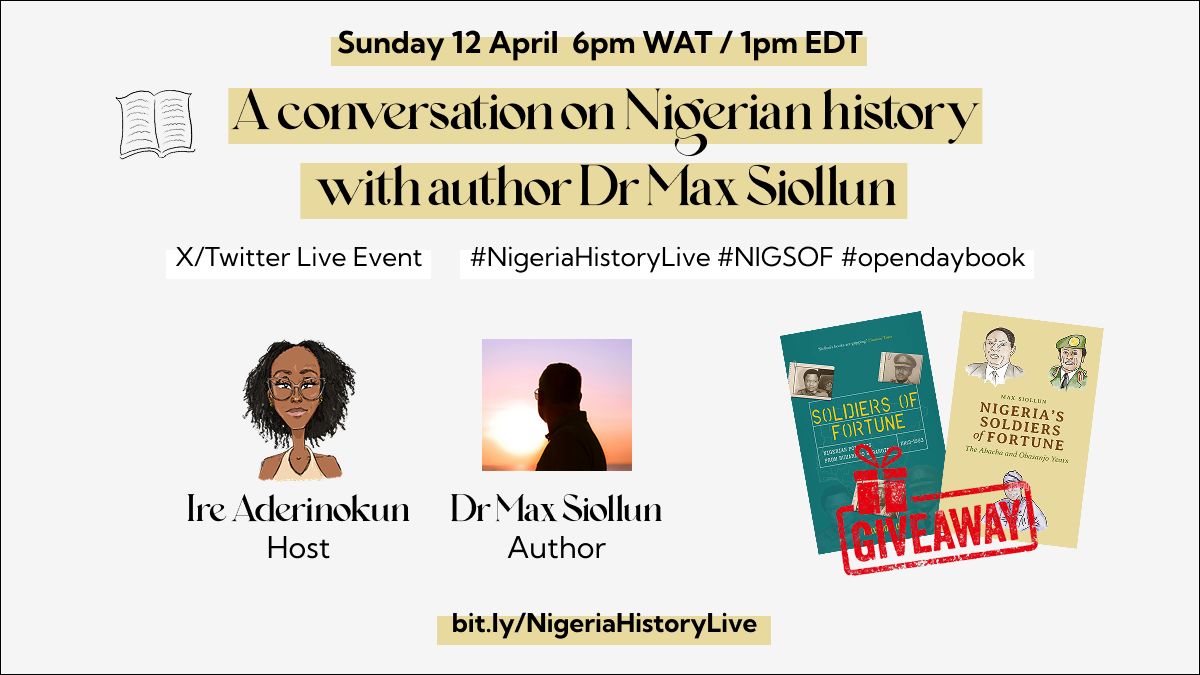
We'll also be giving away free copies of his books! You can register at bit.ly/NigeriaHistoryLive to get notified about the event and find out more information about the giveaway. Hope you can join!